 BabyDrift Games
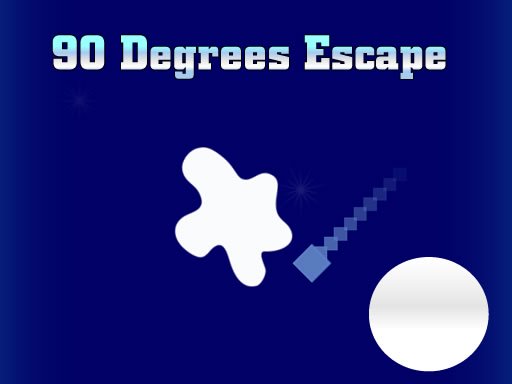
Right Angle Reflex Challenge earns its difficulty from a single design choice. By restricting movement to 90-degree increments, it removes the free-form dodging found in most arcade survival games and replaces it with commitment and route planning. The escalating speed gives the mechanic room to bite, and the minimalist presentation keeps attention on incoming objects. It suits players who enjoy short, repeatable reflex tests rather than long structured campaigns. The obvious limitation is variety: the core loop does not change, so its appeal depends on how much you enjoy refining the same skill.
Right Angle Reflex Challenge limits every input to a 90-degree turn. You cannot glide diagonally or make gradual adjustments. Each press of an arrow key or swipe changes your heading by a quarter turn, so the path you commit to is the path you must live with until the next input. That constraint turns a simple dodge game into a spatial puzzle: the question is rarely whether you can move, but whether you should turn now or hold course for one more beat.
Objects approach from multiple directions. Colliding with any one ends the run, and your score reflects how many you avoided. The opening pace is forgiving, which gives you room to internalize the turning rule and read incoming trajectories. As the session continues, object speed climbs. The same 90-degree limitation that felt manageable early becomes the central pressure, because faster objects shrink the window between seeing a threat and committing to a turn. There is no finish line; the run ends only on impact.
On desktop, arrow keys handle direction changes. On touchscreens, swipe gestures perform the same function. Both schemes map one action to one turn, so there is no complex input to learn. The skill sits in timing and route selection rather than control mastery. Because the game runs in a browser with no download or registration, a session can start in seconds and last as long as your focus holds.
The minimalist visual design removes decorative noise, which matters when objects arrive from every side. Keeping your attention near the center of the screen lets you register threats earlier than chasing them at the edges. Anticipating a direction before the turn is forced tends to work better than reacting at the last moment, since overcorrecting with short, precise inputs is easier to recover from than a panicked double turn.
Sign in to comment
You must be logged in before posting a review or rating.
No comments yet. Be the first to comment!





Editorial Notes