 BabyDrift Games
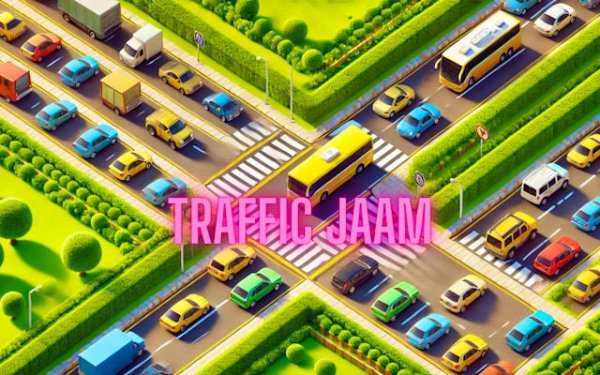
Gridlock Escape: Traffic Puzzle strips the genre down to one rule: vehicles slide only along their own lane. That constraint creates real decisions, because freeing the target car often means moving three others first. The undo button and lack of a timer keep the tone calm rather than punishing. Players who enjoy spatial reasoning and methodical trial and error will get the most from it; those seeking fast action or variety in mechanics may find the loop narrow.
Every puzzle in Gridlock Escape: Traffic Puzzle centers on a single objective: get one designated car off the grid by guiding it to the exit. Vehicles of different sizes occupy the intersection, and each one can only slide forward or backward along its own lane. That restriction is the entire puzzle. You cannot rotate a car, lift it, or move it sideways, so the order of your moves decides whether the target car ever reaches the exit.
The difficulty comes from interdependence. Moving one vehicle may open a gap for another, or it may close the only route the target car had. Because every piece is locked to its axis, a careless slide early on can stall the whole board, which is why the game rewards reading the full grid before touching anything.
Early puzzles use small grids and few vehicles, so the basic rule set becomes clear quickly. Later puzzles expand the grid, add more vehicles, and reduce the empty space between them. Some levels introduce obstacles that block movement entirely, forcing you to route around fixed barriers rather than treating every square as usable. The ramp is gradual, and each solved puzzle unlocks the next, so the challenge increases without a sudden jump in complexity.
Interaction is built for both touchscreens and desktop. Tap or click a vehicle to select it, then drag it or use arrow prompts to slide it along its lane. An undo button reverses the last move, which makes trial and error cheap and encourages testing an idea instead of restarting. The target vehicle and the exit are visually distinct, and the interface stays uncluttered. Standard mode has no timer, so you can study a layout for as long as you need.
Gridlock Escape works without an internet connection, which suits commutes, flights, or anywhere connectivity is unreliable. It runs on phones, tablets, laptops, and desktops, and the responsive layout adjusts the grid and controls to different screen sizes. Progress does not depend on being online, so the puzzle itself remains the only thing you have to solve.
Sign in to comment
You must be logged in before posting a review or rating.
No comments yet. Be the first to comment!








Editorial Notes