 BabyDrift Games
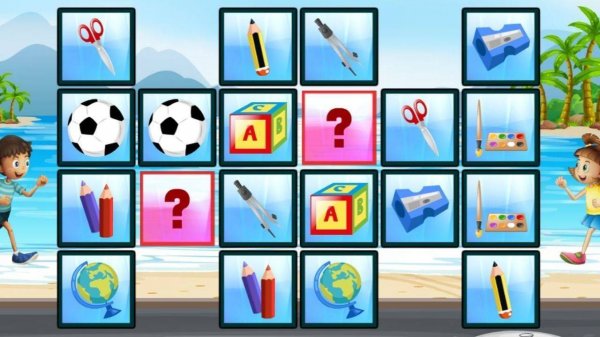
Classroom Pair Recall focuses on the classic memory matching loop: flip two cards, remember what you saw, and clear the board. Its strengths are a gentle difficulty curve, a clean school-themed presentation, and controls simple enough for young children. The main limitation is that the input describes no timer, penalty system, or multiplayer mode, so players seeking pressure or competition may find it too relaxed. It best suits casual players and families who want a short, low-stress mental exercise.
Each turn in Classroom Pair Recall begins with two card flips. The goal is simple: find identical images. When a pair matches, both cards remain face-up and are removed from consideration. When they do not match, the cards flip back after a short pause. That pause is the heart of the challenge, because it gives players a brief window to note each picture's location before the board resets. The loop repeats until every card has been cleared. Success depends less on speed and more on holding a mental map of the grid.
Progression in Classroom Pair Recall comes from larger boards and more items to track. Early rounds use a small set of cards, which lets new players learn the flip-and-remember rhythm without pressure. Later stages expand the grid and increase the number of distinct images, so recall has to be faster and more deliberate. The difficulty rises gradually rather than in sudden spikes, which keeps the experience approachable while still demanding sharper memory as boards fill up.
The school theme gives the game a warm, familiar tone. Card images show classroom items such as pencils, books, and apples, drawn in bright, friendly colors. The interface stays clean and uncluttered so attention lands on the cards, not the menus. Backgrounds and animations are subtle by design, avoiding distractions during recall. This visual approach suits children and remains pleasant for adults who want a calm puzzle rather than a loud one.
Classroom Pair Recall is built for quick play. A single board can be finished in a few minutes, which makes it easy to fit into a break. Controls are limited to clicking or tapping a card to flip it, so no reading or complex instructions are required. Longer sessions are still possible because each completed board provides a natural stopping point, and the next board is always ready when the player wants to continue.
Sign in to comment
You must be logged in before posting a review or rating.
No comments yet. Be the first to comment!




Editorial Notes