 BabyDrift Games
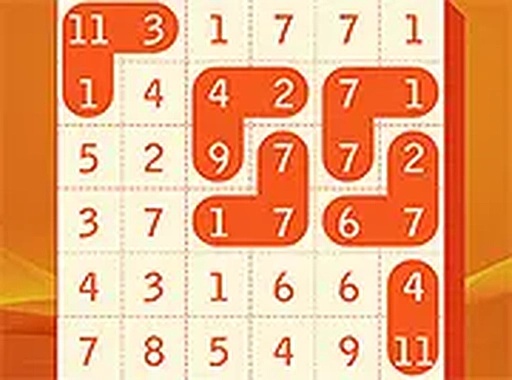
Sum Fifteen Daily Grid is a focused math puzzle rather than a sprawling game. Its strength is the way a single rule, every connected region must total fifteen, creates cascading decisions across the board. Four grid sizes let players scale the challenge, and the daily puzzle structure provides a reason to return without requiring an account or installation. The minimal presentation suits the logic-first design. It will appeal most to puzzle players and educators who want arithmetic practice embedded in genuine spatial reasoning. The trade-off is limited variety: the core mechanic does not change between sessions.
Each puzzle hands you a rectangular board filled with numbers. Your job is to slice that board into connected groups so that the digits inside every group total exactly fifteen. No number can be left out, and no group can be empty. The catch is that every placement ripples outward: claiming a cell for one region removes it from its neighbors, so a move that looks tidy in one corner can strand a digit elsewhere. That interdependence is what turns a simple arithmetic exercise into a spatial logic problem.
Four dimensions are available: 6x6, 7x7, 8x8, and 9x9. The smallest board is the gentlest entry point, since fewer cells mean fewer possible groupings and faster feedback when you make a mistake. As the grid grows, the number of viable partitions multiplies, and you will spend more time planning several moves ahead. Because you choose the size yourself, the same game can serve as a five-minute warm-up or a longer session that demands real concentration.
A new grid is published every day, and everyone who opens the game works on the same layout. That shared puzzle gives the daily habit a social dimension even without direct interaction. Because each puzzle is generated fresh, you cannot rely on memorized solutions from previous days. The daily reset also means you never fall permanently behind: skip a week and you simply start again with today's board.
[IMG_1] The game runs entirely in a web browser, so there is nothing to download or install. It works on phones and desktop computers alike, and a full-screen mode strips away surrounding interface elements when you want to focus. The visual design stays minimal, which matters for a puzzle where a single misread digit can send you down the wrong path. [IMG_2]
Sign in to comment
You must be logged in before posting a review or rating.
No comments yet. Be the first to comment!





Editorial Notes